
Getting Your Exterior Color Approved by a Brentwood HOA
An HOA color submission is about more than the color name. Architectural committees in Brentwood and Franklin also look at sheen, undertone and how the body, trim and accent colors work together. Get those details into your submission and it is much easier for the committee to say yes.
What HOA architectural committees check
Many neighborhoods in Brentwood and the Cool Springs area have an approved-colors list or a submission process through an architectural review committee. They're not judging your taste. They usually look at three things: whether the color falls within (or close to) the approved palette for your section, whether the sheen suits the surface, and whether the trim, body and accent colors sit well next to neighboring homes. Your covenant may specify a sheen for certain surfaces, so read that section before you choose.
Before anything is painted, pull your HOA's architectural guidelines and ask what the committee wants to see. A large painted sample board shows undertone far better than a small chip, because chips are hard to judge against a whole wall of brick in afternoon sun. Look at the board outside, in sun and in shade, before you submit it.
A real three-color scheme from Brentwood
A Brentwood exterior we wrote about on our old blog shows how body, trim and accent colors can work together. The siding and the main body of the house went to Sherwin-Williams White Duck (SW 7010), in eggshell, satin and semi-gloss depending on the surface. Doors, frames, the garage door and the vinyl shutters went to Iron Ore (SW 7069) in semi-gloss, and Attitude Gray (SW 7060) went on the front door sidelight and the attic vents. The paint was Sherwin-Williams Emerald. One light body color, one dark accent and one middle gray is an easy scheme for a committee to read.
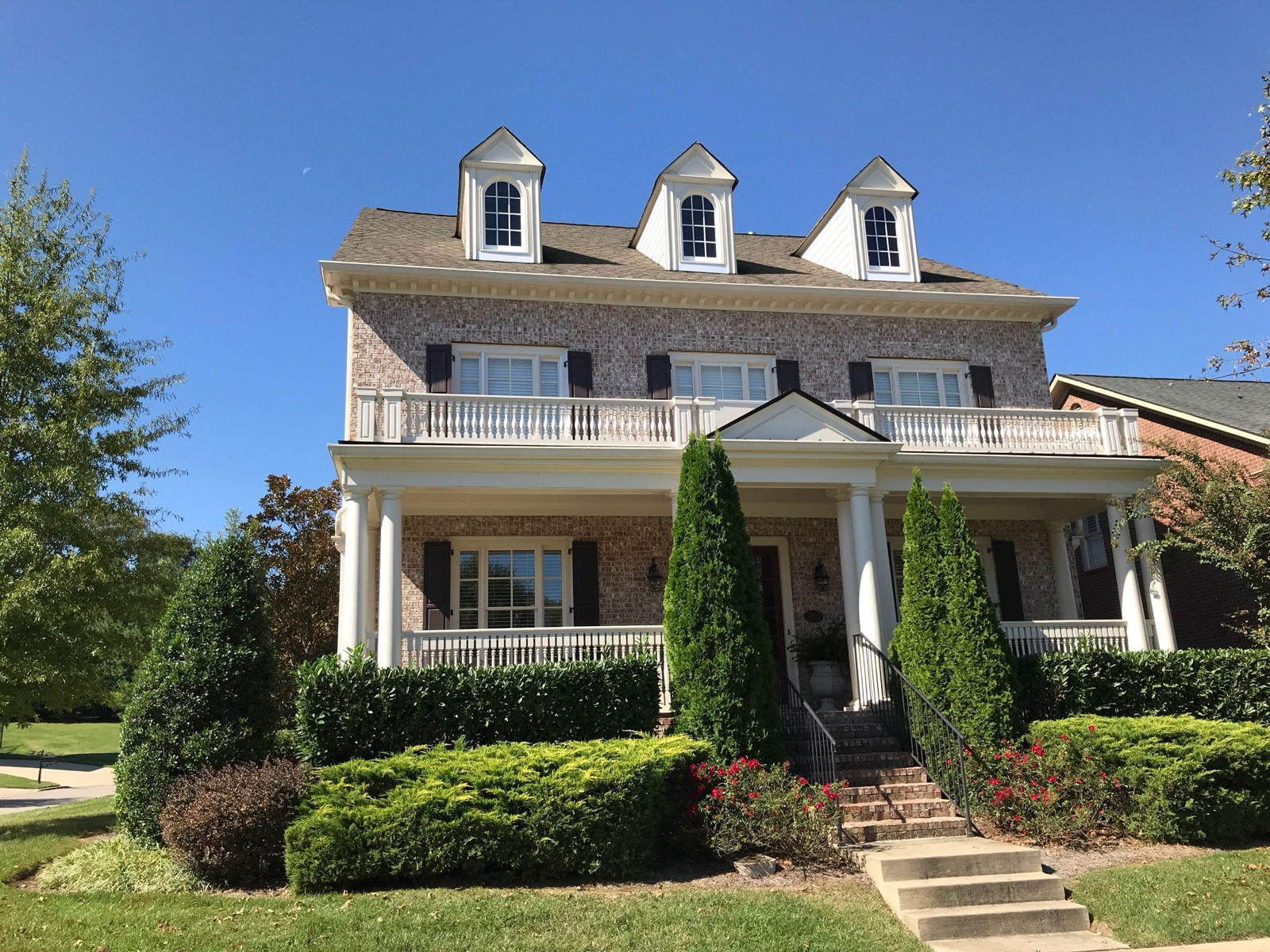
Exterior repaint in Stone Creek Park, Brentwood.
Protecting brick and Hardie facades
Brentwood and Franklin have a lot of larger custom builds with mixed brick-and-Hardie facades, and each surface ages differently in our climate. Middle Tennessee gives you real freeze-thaw cycles in winter and long stretches of heat and humidity in summer. Both stress paint, just in different ways.
For brick, moisture comes first. Painted brick that's still wicking water from below grade or from a bad gutter will blister no matter what coating goes on it, so the source of the water has to be fixed and the wall has to be dry before painting. Fresh mortar and brick are alkaline, so a masonry primer goes on first where the coating calls for one. The finish is a breathable masonry coating: brick has to be able to let moisture vapor out, and the wrong product can trap water in the wall. See our brick painting page for the options, including limewash.
Hardie fiber cement is more forgiving but has its own rule: joints get sealed with a caulk that meets James Hardie's own requirements before priming, and any exposed cut edges get primed. Skip that and the seams are where the paint fails first, however good the paint is. The siding is washed and given time to dry fully before primer and two finish coats.
Timing your repaint around sun exposure
Homes on more open lots, common around Nolensville, often get harder sun on south and west walls than homes on older, wooded Brentwood streets. If your south-facing wall is chalking or fading ahead of the rest of the house, that's sun, not a paint defect. It can make sense to refresh that side on its own schedule rather than waiting to redo the whole exterior at once.
Spring and fall usually give the steadiest stretches of mild, dry weather for exterior work. The paint label sets the real limits on temperature and humidity, and the schedule follows the forecast, not the calendar.
Next steps
If you're putting together an HOA submission, or your brick or Hardie exterior is showing its age, we'll come look at it and tell you what it needs. See our exterior painting page, read about our work in Franklin, or schedule a free estimate.
- Do I need HOA approval to repaint the same color?
- How long does committee approval take?
- Can an existing color be matched without the original spec sheet?